
Disclaimer
Disclaimer
Disclaimers for ecommerce stores are statements designed to help protect you and your business from liability issues that arise when users visit your site or purchase your products or services.
Disclaimers specifically disclaim responsibility for a variety of damages, both real and perceived.
A good example of this would be an online vitamin seller that uses a disclaimer to let users know that the information provided on its website doesn’t constitute professional medical advice. (This type of disclaimer is often referred to as a no professional advice, or a no professional relationship disclaimer.)
In addition, ecommerce store owners often use disclaimers to inform users that they’re not responsible for content posted by third-parties. Third party disclaimers are particularly important if your ecommerce site allows customers to leave reviews, chat in forums, or post general content. If so, you should make it clear that such material may be inaccurate or offensive, and that you bare no responsibility if it is.
Since no two ecommerce stores are exactly alike, you’ll need to decide which disclaimers apply to your business. Whichever you choose to include, it’s important to make sure that they’re clearly written, easy to find, and that they adequately address the risks that apply to you, your business, and your users.
Are Disclaimers Legally Required?
Most disclaimers aren’t legally required.
However, if you engage in affiliate marketing, the Federal Trade Commission (FTC) requires you to use an affiliate disclaimer to let users know if you’re getting paid to promote a product or service, or if you get a commission when someone makes a purchase after following one of your links.
But just because most disclaimers aren’t legally required, it’s still wise to have them to ensure maximum protection.
That said, disclaimers won’t help if you engage in illegal, dishonest, or deceptive behavior. For example, you can’t hide behind an Errors and Omissions disclaimer if you knowingly publish inaccurate material or make claims that you know aren’t true.
Why are Disclaimers for Ecommerce Stores So Important?
Without disclaimers specifically tailored to your business, your ecommerce site could be a liability instead of a steady source of revenue.
To recap, disclaimers for ecommerce stores are vital because they allow you to disclaim responsibility and avoid liability for damages that may result when customers visit your website or buy a product or service online.
Additionally, disclaimers for ecommerce stores can:
- Promote clarity and transparency
- Help you establish or protect your reputation
- Build trust between you and your customers
- Facilitate the buying process
- Show potential customers that your practices are inline with industry standards and those of your competitors
- Warn users about the risks associated with using your website, products, and services
In addition, disclaimers may discourage customers from taking legal action if they’re unsatisfied with a purchase or feel they’ve been harmed in some way. After all, if your disclaimers are easy to find, easy to understand, and adequately disclaim your liability in various situations, it should be clear that legal action would be an exercise in futility.
It’s also worth noting that disclaimers can only minimize risk, but they can’t protect your ecommerce store from all liability.
What Disclaimers are Commonly Used with Ecommerce Stores
The following disclaimers are commonly used by owners of online shops and ecommerce sites, and they may be relevant to your business, too.
Disclaimer of Warranties and Limitation of Liability
A disclaimer of warranties can protect your ecommerce store against legal action and financial claims if you sell faulty products or services or distribute inaccurate or incomplete information. And a limitation of liability disclaimer will help limit your liability in the case of legal issues.
But even if you sell top-notch merchandise and are a stickler for details, you should still use a disclaimer of warranties to let users know that they use your site at their own risk, and that web content, products, and services are provided “as is.”
While some disclaimers for warranties address web content only, others cover what is and isn’t covered when a customer has a post-purchase issue with a product or a service.
Here’s an example from Tackle Warehouse that references the company’s website, products, and services:
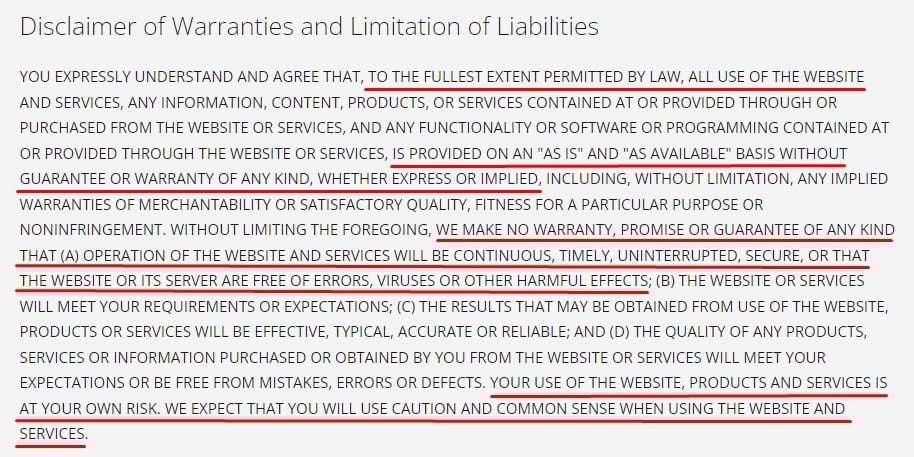
In this example from Dewalt, the company clearly differentiates between its website and products:
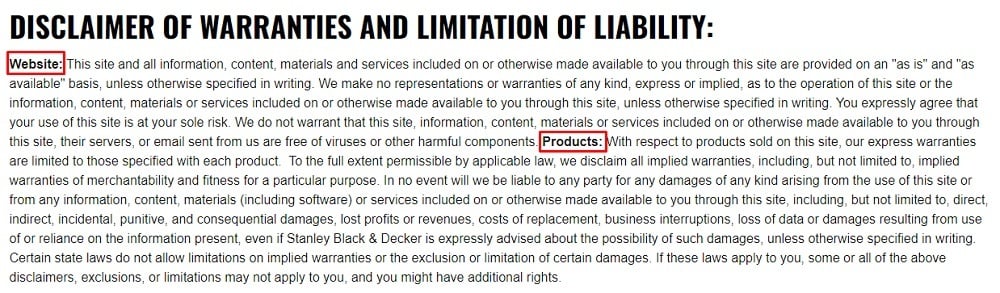
Whereas a disclaimer of warranties should address what your business does and doesn’t promise, a limitation of liability should cover your business’s responsibilities and warn users that your liability is limited to the fullest extent of the law when they use your website or ecommerce store.
Here’s an example from Fishermanshub:
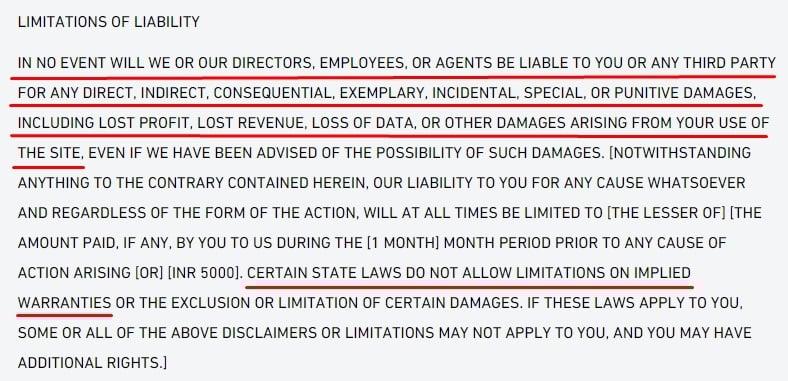
In addition to establishing the limits of its liability, Fishermanshub also lets users know that the laws of some states impose restrictions on Limitations of Liability and that customers who reside in those states may have additional rights